ann@annrichardson.com
  • Home
  • Demos
  • About
  • Coaching
  • Clients
  • Blog
  • Contact

Audiobooks

Homework Before Narrating: Pre-reading and Prepping the Book

by Ann Richardson

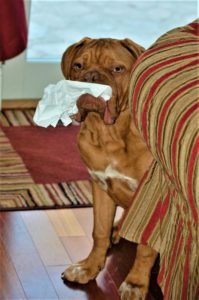
Herbie ate my book-prep notes.

I finish narrating, turn off my “RECORDING” sign, and step out of the booth for the day. Time to make dinner, feed the dogs, and relax a little. The operable word here is “little”. After tending to family and animal obligations, I sit down to enjoy some TV with my husband, pull my laptop onto my lap, and open the pdf for my next project.  Yes, I’m only 1/3 of the way through narrating my current book, but if I wait until I’m finished to begin prepping the next book, my schedule will be impacted and I’ll be punishing myself to meet deadlines.

I’ve been asked many times if I read the book before I begin narrating.  Resoundingly, yes, and the rest of this blog focuses on the pitfalls of not doing so, plus what “prepping” a book entails.

OH SHIT. A RABBIT HOLE.
Say I have a non-fiction book on high density animal operations.  This is a high-level book with many technical, medical, and latin words describing zoonotic infections, infections with AMR bacteria, and respiratory disorders.

I don’t pre-read and prep… I haven’t even made it through the introduction and am now stopping mid-sentence, going online to research pronunciations. I go to YouTube to find examples of lectures on this topic in order to hear the word spoken. You know what happens then? YouTube suggests another video for me to watch. And oh, looky!  A cute kitten video!  Aawwwwwww, puppies!  Oh, I should really check my email while I’m at it. Rats, did I forget to pay off my credit card?  Hey, what’s going on in that FaceBook group? I’d better chime in and add my two cents to that flaming thread on outsourcing. What was I doing in the first place? I really ought to get back to narrating… wait…. How do I pronounce that word again?  Shit. Back to YouTube….   This is known as “falling down a rabbit hole”, and is one of the biggest productivity killers I’ve faced. I have a precious recording window of quiet time during the day; I cannot afford to spend half of my time in the booth falling down rabbit holes. I need to look up all of these words BEFORE I begin narration so that I can perform the audiobook smoothly, maintaining pacing, energy level, and vocal quality throughout. Interruptions damage this consistency.

OH CRAP. A SURPRISE ACCENT.
A fictional romance comes into my queue.  I figure, “I don’t need to pre-read this book; I’ve already narrated three books in this series, I know the characters pretty well, and I really don’t have time to spend on it. I’m just gonna get in there and do it.

You know what happens then? I narrate happily away and learn that the female protagonist has a new boyfriend, and cool, everything seems to be going well. Yay for her. Until the second half of the book, when the author reveals that this boyfriend has a strong Irish brogue. Crappola. The time it will take to go back and re-record all of the dialog involving this Irish fellow, giving him his accent, is going to blow my schedule out of the water. Not to mention hampering the aforementioned consistency of energy, pacing, and vocal quality.

Not prepping a fiction book is detrimental in other ways, as well. Authors will sprinkle clues and background throughout that define and refine a character. You may learn that your heroine’s little sister has a lisp. But without pre-reading and absorbing the other characteristics that flesh out their personalities, the narrator cannot climb into that character’s skin and perform AS the character. Maybe you assume “lisp” means shy or reticent to speak up, when in reality, the little sister loves the limelight and is a child prodigy who discusses Einstein’s theories with anyone who will listen. In a recent coaching session, I asked a beginning narrator how he arrived at his decision to voice a character the way he did. He replied “I pictured her as an actress in one of those old-timey movies. You know, a real grande dame.” We then explored the pitfalls of playing a stereotype, rather than inhabiting the character’s true self. Without pre-reading, a narrator misses out on the hints embedded throughout the book that help form the character.

WHAT SKILLS ARE NEEDED TO BECOME A BOOK-PREPPER?
If you are interested in becoming a part of the thriving audiobook industry, but not as a narrator, maybe becoming a professional book-prepper is for you!  Here is what a prepper is expected to do:

-Research pronunciations of all unfamiliar words and proper nouns and acronyms (are they spelled out or if they form something pronounceable, is it commonly spoken as a word?  Example: “ARF” is known as “arf” but the acronym stands for “Animal Rescue Foundation”).  My blog “How Do Narrators Know How to Pronounce Stuff?” would be a great help to read before you start.

-Give not only a synopsis of the book, but of each chapter.

-Give character breakdown, including physical attributes, significant events about their past that contribute to characterization (example: she grew up in South Carolina, has a heavy accent, and was kicked in the head by a mule and has a perpetual stutter. Or, he was in the military for most of his life and his speech patterns are stilted and formal.) I recently asked my prepper to give me suggestions of movie characters he thought might be similar to those in my book.  He made several helpful suggestions such as “his personality is similar to ‘Chunk’ in The Goonies. This is applicable mainly to fiction, but depending on the nature of the non-fiction book, it may occasionally pertain.

Be able to create a spreadsheet and populate it with words, their phonetic spelling, and a link to a site where the pronunciation is audible

Be able to write coherently enough to compile a character list, including any history or attribute that would contribute to knowing how a character would speak (accents, posture, tics, or the way they speak or interact with others… is she always rushed? Is he a surfer-dude? Does the father work 18 hours a day and come home exhausted?)

Be able to write a clear, concise, brief synopsis of each chapter and/or the whole book.

Be technically capable of email correspondence and file sharing.

Be reliable and don’t miss deadlines!

Book preppers charge between $25 and $45 per hour. It is important that they be thorough, but also fast. Of course, each book is different, and non-fiction technical books will obviously be more labor-intensive, as will books with lots of foreign phrases and words.  I narrated a 10.5 hour audiobook that took the prepper 12 hours to prep. It was a simple historical romance, so it did not require the heavy lifting of foreign words or technical jargon. A narrator or publisher who depends on prepping services must be able to afford them, and falling down rabbit holes and charging for that time is not a tenable business practice.

Once you’re adept at these aspects, join audiobook social media groups and learn all you can about the industry. If someone posts inquires about needing a prepper, you could respond with your credentials/availability/rate, and whatever you’d like them to know.

In conclusion, hiring a book prepper is not “cheating”, rather it’s another avenue for doing due diligence and delivering an informed performance.  If you’re considering becoming a book prepper, you’re welcome to reach out to me and I’ll be happy to chat with you.  ann@annrichardson.com
The FUN Side-effects of Being An Audiobook Narrator…

by Ann Richardson

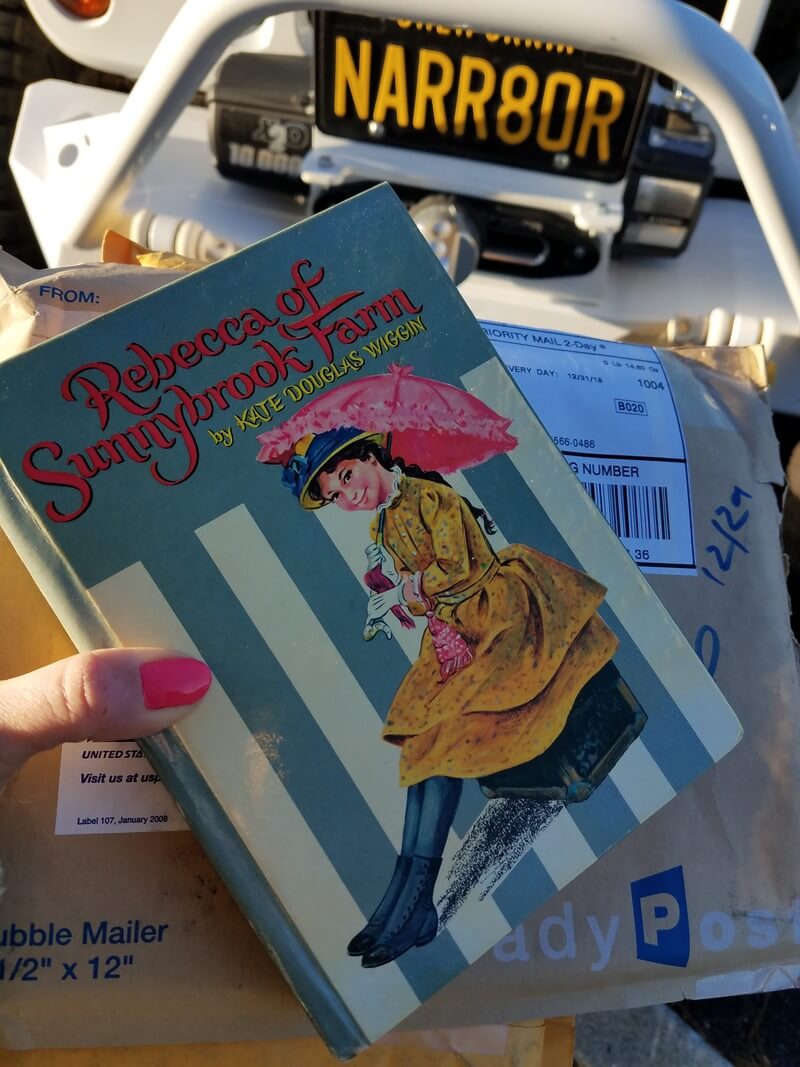
A kind listener, a new friend, took the time to send me this gift of a classic I’d narrated..

This summer, my dear husband and I celebrated our 30th wedding anniversary in Sedona, Arizona.  We love the area, the food, and the activities.  We took a “Pink Jeep” tour into some Indian ruins and did a little hiking. Our guide, Don, was articulate, genial, knowledgeable, and devoted to his occupation. We enjoyed the short drive to our destination as we each introduced ourselves and shared a smidgen about ourselves. The other couple was a teacher and her husband who loved woodworking. My husband was able to share some discussion about his affinity for woodworking, and when it came time to tell about myself, I said I was an audiobook narrator.  To my delight, the Jeep was full of enthusiastic readers and listeners! Don took us on a lovely tour of the ancient ruins and really piqued our interest in the local history.  As he dropped us off at the end of the tour, he asked for my business card, and indicated he’d like to listen to one of my narrations. So, I gave him one and told him to email me and I’d help him pick one he’d likely enjoy.

About 2 weeks later, Don emailed me, and I helped him find an audiobook he’d be sure to enjoy. The classic “Rebecca of Sunnybrook Farm” by Kate Douglas Wiggin, was what he settled on, and I mentioned how much I enjoyed narrating it. I mentioned, however, that I had never been able to find the original print book in any bookstores or antique malls, and then wished him happy listening.

Fast-forward to December 31, when I drove to the post office and picked up my mail. A package was waiting for me, and lo ‘n behold, it was an old hard-back copy of “Rebecca of Sunnybrook Farm” sent by my friend, Don! He’d vacationed in New England over the fall and came across it in an antique store and remembering my lament at not being able to find one, he picked it up and sent it to me. How cool is that!?

That is just the tip of a HUGE iceberg of nice people I’ve gotten to meet and know over the years I’ve been a narrator. The overwhelming good will, camaraderie, and generosity of my peers, clients and listeners have kept me afloat many times when I felt like quitting.

Other side effects of being an audiobook narrator?  Learning new words (at least to me) like “hirsute”, and “floccinaucinihilipilification”, and then trying to use them in casual conversation; knowing the proper way to say common abbreviations out loud, such as “I.E.”, texting shortcuts like “IKR”, and many Latin phrases, and TONS of biblical words. (All of this would make me seem a bit hoity-toity, if only I could remember them long enough to use them.) And the obvious draw, I got to read. All. Day. Long. I got to read the most fascinating books I would not have chosen for myself and broaden my horizons.

But one of the coolest side effects of being an audiobook narrator has been the ability to work from home and somewhat control my work schedule. I was able to be home in the afternoons when my boys came home from school, ready with a snack to get a recap of their day. I could take the dogs to their vet appointments mid-morning, and I could occasionally take off on a spontaneous afternoon fishing trip with my husband (knowing I’d be recording while they slept, to catch up and meet those deadlines.)

Aside from these wonderful benefits, I get the peace and joy of bringing an author’s words to life. That is really good for my soul.

The Angel in the Book (a true story)

by Ann Richardson

The Angel in the Book

I could see the puffs of my breath in the light of the streetlight, as I quickly trotted two houses down to my neighbor’s home, awkwardly juggling a Christmas gift tucked under one arm, a bottle of wine under the other, and a fruit tart in my hands. The women in my close-knit cul-de-sac have been gathering together for years now for our monthly bunco night, reveling in each other’s company and catching up on milestones and events around the ‘hood.

I knocked on her door. A rush of warmth, laughter and delicious smells met me as I stepped into her beautifully decorated home. Exquisite desserts and appetizers covered every available inch of space on the counters and kitchen table, and the livingroom table was heaped in anonymous gift bags and boxes to be exchanged later, in lieu of our usual bunco game.

The laughter and stories around the dinner table made the food taste even better, somehow, and there was no rush as we moseyed into the livingroom, dragging kitchen chairs in and squeezing all of us around that pile of unmarked gifts. A quick group photo, and then the game began. Our hostess read a special poem with directional words included in it, and upon hearing those words, the gifts were passed around sometimes to the left, sometimes to the right. At the end of the piece, we each had a different gift than when we’d started. One at a time we opened them, and if we wanted, we could “steal” someone’s gift instead of opening the one at our own feet, and so it was that I was the owner (briefly) of a plush, furry blanket, an electric wine bottle opener, a Moscow Mule set (alcohol included!), until finally, with one woman left, that was stolen from me, too! I’d had my eye on another decadently soft, fluffy blanket, and had every intention to steal it, when I saw there was one unopened gift bag left and felt compelled to choose it instead of the petty larceny I had planned.

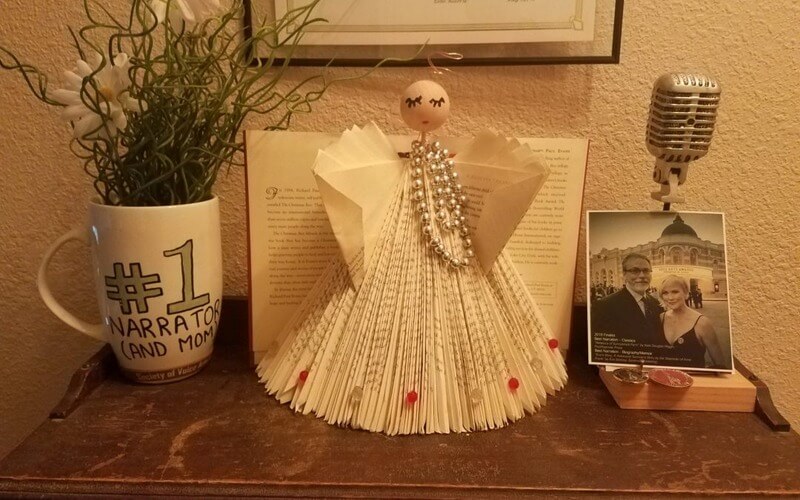
Out of the bag came a very beautiful angel, crafted skillfully from a book, it’s gown and wings formed by the folded pages. I, and many of my neighbors marveled at the coincidence of my ending up with that particular gift, since I am an audiobook narrator and thus, an avid book lover. Now, the premise of the gift exchange is anonymity, but I looked around those lovely faces in the circle and asked who made this gift that fit me so perfectly. The artist was across the room and raised her hand. She said, “I was thinking of you when I made that.” I got a little choked up as I thanked her, and with blurry eyes, looked it over again, and then gently placed it back in its bag.

The gift exchange over, we began to disperse, some of us refilling a wine glass or nibbling on an hors ‘d oeuvre, or just moving to chat with someone we hadn’t had a chance to talk with yet. The artist came over to sit by me and explain how the angel was made, and another neighbor came over and asked what book was used to make the angel. I brought her out of the bag and as I turned her over in my hands I froze, my heart stopping for a moment when I read the title of the book, “The Christmas Box” by Richard Paul Evans. In a flash I was transported to 1995, sitting by my father’s bedside in the hospital. The flashing lights of a heart monitor and the rhythm of the respirator breathing for him weaving a sad background to my voice, as I read this very same book aloud, to his unresponsive face. I remembered the smell of sterile equipment and the faint aroma of the peach lotion my sister and I had massaged into his feet and hands earlier in the day. But in the wee small hours of the morning, there I sat in his darkened room in the ICU, tears streaming down my face, as I read him this beautiful Christmas story about a widow and a young family that comes to live with her.

Quickly refocusing my attention on the here and now, and the book-angel in my hands, I couldn’t contain the sob that escaped me, and tears began to course down my cheeks. I was so embarrassed to be crying at this happy gathering, and felt my face grow red as I tried to squelch the emotions that overwhelmed me. My angel-maker gracefully and perceptively distracted me by describing how she crafted the gift, and I was so grateful for the chance to regain my composure, if only for a moment. I wanted to share with everyone how touched I was by this poignant coincidence, but every time I opened my mouth, my voice quavered in a high-pitched choking sound, and I would break down again. I think word eventually made it around the room, and my dear friends who were not clustered around me as I blathered, now all know the reason for my emotions.

The day after the party, as I write this, my emotions are still raw and near the surface, and I feel a headache coming on from the effort of keeping them under control. I need to get into my recording booth and finish narrating a book whose deadline is a bit too close for comfort, and if I cry, I lose half an hour of valuable work time, due to the drippy nasal tones that will be audible I my voice. I have placed my book angel outside my booth on my great grandmother’s antique sewing machine, which houses my recording equipment. There she will stay, long after the Christmas decorations have been put away in the garage. I am so grateful to have been in the presence of dear friends when this happened, and I am also grateful that the memory of my father is present with us this Christmas in a new and beautiful way.

PERSONAL SAFETY – #MeToo

by Ann Richardson

https://hersmoothvoice.com/personal-safety-metoo/

It’s a sunny, warm afternoon and I’m feeling at the top of the world. I’m on my way to a client’s studio to record my first off-site job. Up till now I’ve recorded only a handful of jobs in my home studio, and being a relative newbie, am anxious to start making a name for myself, as well as money. I feel pressured to accept almost any reasonable job that comes my way, however, I’ll be damned if I’ll let my lack of experience and insecurities crack through the surface of my professional veneer. I continue walking down the sidewalk, admiring the boutiquey store fronts and small eateries as I pass. After a left turn, suddenly there are no more shops or restaurants and I find myself in an industrial-type warehouse district. I walk through a parkinglot under a freeway overpass. Another left turn and I find myself nearly at my destination, but it’s at the end of an alley flanked by brick buildings, littered with overflowing dumpsters and lined with razor-wire-topped chain-link fencing.

Oh. My. God.
What have I done? Immediately my good mood and bravado vanish and I realize that I have told no one where I was going. I am all alone. I did not even Google this client. I am absolutely incredulous at my naiveté, and I am now terrified. Somehow I am stupid enough to continue through the alley, into the building, walk up the rickety wooden stairs and find myself in a beautifully-equipped recording studio. The client is a lovely man; very professional, and friendly. I am slightly reassured, and calm myself enough to record the job without looking or sounding like a scared rabbit. He cuts me a check on the spot, we shake hands, and I go on my way.

I shook with fear and self-loathing as I drove home, thanking God that this experience had a happy ending. How could I have been so foolish? Immediately my children come to mind. I would never let them do something like this without making sure I knew where they were going, how they were getting there and back, how long they’d be there, who they were with, and what they were doing. Why didn’t I place this same value on my own personal safety? I still have no answer for this.

Another time, not too long afterward, I attended my first audiobook mixer in Hollywood. I was so proud of the great hotel rate I was able to find online, and had no qualms flying by myself (it was only an hour-long flight), checking in, staying by myself, and enjoying the mixer. I was so excited to start making valuable contacts in the industry.
I chatted happily with my fellow shuttle-bus passengers, and soon the bus stopped at my hotel. I should have noticed something was not right when the driver didn’t want to let me out. He was very concerned and questioned if I really meant to book a room at this particular hotel…The Cecil Hotel. The bus passengers grew quiet as I peered out the window of the bus and took in the scene: Homeless people sat on the sidewalk outside the hotel, one poorly-dressed, disheveled man trudged down the sidewalk staggering under the weight of an enormous wooden cross, bigger than himself, and yelling about the end times being imminent. I paused, then bravely laughed it off and said I had no worries. He helped me off the bus but lingered at the curb watching (along with the other passengers) as I made my way inside the hotel on “skid row” in Los Angeles.

I checked into my room (the desk clerk sat at a desk behind bars…that should have clenched the deal), changed into my cocktail dress and primped for the mixer. Then I sat on the very edge of my bed and surveyed my surroundings. The dirty smudged window looked directly at the brick wall of the adjacent building, there was one corroded spigot coming out of the wall over a rust-stained porcelain sink. The community bathroom and shower were down the echoey hard-tiled hallway. I recounted the environment in the lobby and outside on the sidewalk, and asked myself what it might be like returning at midnight from the mixer, dressed like what I was now convinced was how a hooker would dress. This time I made a smarter decision and checked out. But suffered a scary 20-minutes, waiting for the cab in the lobby, during which a very large, homeless-looking man wandered into the hotel, stopped directly in front of me, looked me up and down very lewdly and said: “Lady, you got it aaaaaawwwwwlllll goin’ on. Wanna take a ride with me in my drop-top Bentley? It’s just around the corner…” Ignoring the fact that his voice was very deep and sonorous and could’ve given Barry White a run for his money, I continued to stare at my cellphone, until what felt like hours later, a policeman came into the lobby (a routine beat for him?) and shooed the man away from me and out the door.

I arrived at the mixer, enjoyed myself, and happily spent the evening in a very white, very pristine, VERY expensive “W” hotel which had just opened that week. Yes, I paid five times more than what I paid at the Cecil Hotel, but I was safe.
Many years later, a news story caught my ear as I was heading out the door to drive carpool to school…. A young woman had been found dead in a water tower atop the Cecil Hotel. I was very shaken by this news story, and it was hard to focus on anything that day. God must have special plans for me, because it could have all ended so very badly.
The reason I bring up these two experiences is not to highlight my own thoughtlessness, although that is inevitable in the telling. I want to stress how very important it is for people, especially women, to be smart about their own personal safety. Recently the #MeToo movement has unearthed even more evidence that shows us we need to place a high value on our own safety and well-being and take precautions to ensure, as much as possible, that bad things don’t continue to happen to us. And in the sharing of our experiences and ideas, we will foster an awareness of how we can be safer and stronger. The blame does not lie on the victims’ shoulders, but the improvements will come because the victims have been strong enough to step forward and bravely shine light where it has been dark for too long.

The woman who first encouraged me to get into voiceovers, then mentored me for a year, ultimately guiding me into audiobook narration, recently joined many other women in speaking out against a sexual predator in the voiceover industry. I cannot speak highly enough of Heather Costa and the others. Their bravery, eloquence, and integrity in pursuing action to remove this predator voiceover coach from circulation, reached the radar of CNN. In the article published today, February 8, 2018, they describe how his lewd, lascivious and reprehensible behavior impacted their lives, not knowing it was happening to other women, too. I encourage anyone reading this blog to read CNN’s article here: https://www.cnn.com/2018/02/08/us/metoo-voice-coach-peter-rofe/.
I am gobsmacked at the sheer number of women who have posted publicly about their experiences, using #MeToo. The times I’ve experienced sexual assault and harassment will live with me forever, and because of that haunting, and because of the strength of the women who are banding together and speaking out, I feel better prepared to defend and protect myself in situations like that, should they happen again. I also feel better equipped to help others who find themselves at risk, and am committed to intervene and help someone who calls on me in need.
Danger lies all around us. Hindsight is 20-20, and I learned from my experiences to not be afraid to say no to a client when instinct tells you it’s not right. It’s more important to retain self-esteem and safety, than it is to record a $300, 30-second radio spot in a shady environment. I learned to budget carefully to stay at a better hotel, rather than seek out the bargain. I could go on and on, but I’d like to move forward and post something helpful, so in an effort to help others avoid potentially dangerous situations, here are some safety suggestions:
1. Travel with a buddy. Whether it is a fellow voiceover friend who is going to the same conference or event, or if it’s your spouse, mother, father, or grown child, do your darndest to have someone with you. Some fun outcomes might be that your expenses are half when you share with a fellow VO, or maybe your family member or friend finds something interesting and fun to do while you’re tied up with industry stuff. Think of it as a mini-vacation!

2. Make sure someone always has a copy of your itinerary, including flight numbers, schedules, hotel address and phone number, event venue, etc. If you are recording at a local studio, Google it first so you are familiar with the surrounding neighborhood, the business itself, and know where you’ll park and how to get there on foot, if necessary. It’s a great idea to take someone with you. After the incident I described earlier, where I found myself in a warehouse district, I went back to record a few more times for the client and I took my son with me both times. I also had a backup; a stay-at-home neighbor agreed to go with me if my son was not available.

3. Check out hotel reviews before you make your reservation. Just re-read my Cecil Hotel story if you’re not sure why.
4. Make scanned copies of important documents such as credit cards, insurance cards, drivers’ licenses and passports, and file them in a cloud-based service like DropBox, where they can be accessed if necessary.
5. Keep hard copies of important phone numbers with you incase you lose your cellphone.

There are many more helpful suggestions on safe travel hints at the following website:
https://www.buzzfeed.com/jessicaprobus/46-incredibly-useful-safety-tips-for-women-traveling-alone?utm_term=.ctY8876Ejk#.upYXXY6eK4

Please be safe. You are loved.

Pseudonyms…Why Would A Narrator Need One?

by Ann Richardson

Narrators’ Hidden Identities

It has been a long-standing topic of discussion in narrators’ circles: “Do I need a pseudonym?” Usually it is the newer narrators who are unfamiliar with the reasons one would choose to record audiobooks under a different name, and are trying to decide if they need one. However, I was reading some discussion threads on Goodreads recently, and it appears some audiobook fans and even authors are not sure of why a narrator would choose to record under a different name.

Authors have long written under pen names for a variety of reasons, and not surprisingly, narrators share many of the same reasons for maintaining a separate identity:

-the content is controversial
-to protect friends and family from being associated with the material
-to protect family from easily discovering your work
-to protect a body of previous work
-to protect a publisher/at a publisher’s request
-to protect a “day job”
-to keep work in different genres apart
– to make their name easier to remember and spell

As I perused the Goodreads threads, I stumbled across a discussion from May of 2013, in which the participants were posting impressive lists of narrators and their pseudonyms. I was taken aback at the casual treatment of narrators’ attempts to keep their identity hidden! I read on, curious to see all of the comments, because I know of many narrators who are active members of Goodreads, and I wanted to learn of their reactions and input on this topic.

The overriding sentiment throughout the discussion was heart-warming for a narrator to read: the folks who were posting these exhaustive lists were enthusiastically “outing” their favorite narrators because they wanted to be sure to follow them, no matter what genre he/she narrated. One message posted by “Diana”, stated,

“Today (May 1) Audible released 31 (!) new titles in the romance category. I’m a heavy duty buyer in romance and I was disconcerted to find that I recognized only 2 of 31 narrator names. I left the site without buying anything because I was only interested in a couple of the books and I’m not inclined nor do I have time for sampling 31 (!) unknown-to-me narrators.”

Subsequent comments speculated on the reasons narrators use a pseudonym. One guess was that it was the publisher who requested a name change; another thought that it was the narrators’ concerns that they might be typecast, and mentioned that in utilizing a pseudonym, narrators were doing a disservice to the readers. Then a member known as “Lea’s Audiobooks” contributed a very important component that should have both authors and narrators perking up their ears:

“Most of these unknown narrator names you are seeing though are first time narrators – more often than not with little to no training. It’s the ‘anyone can read an audiobook in their closet at home without a director’ concept that’s sweeping the industry with lower priced books and often unknown authors. You have probably heard me rant on this but the main thing to remember is that if you buy one of these from Audible and don’t care for the narration, return it. It’s easy – you can return as many times as you want (although I’d be afraid to overuse it) and it sends a message that you don’t care for sub-standard performances all in the name of getting just any romance fix.”

The takeaway lesson in this exchange is (if you’re an author) take care in choosing your narrator, research them, their body and quality of work, and seriously consider the “pay per finished hour” rate structure over royalty share payments, as the better narrators refuse royalty share deals and often demand higher rates. If you are a narrator, do your very best on each production, which may include hiring a professional sound engineer to ensure the technical aspects of your recording are excellent, and also invest the time and money in professional coaching.

As I continued to read, a comment from a narrator popped up. And what a narrator it was who posted! Simon Vance, multi-Audie Award winner and house-hold name to audiobook aficionados, said:

“Let me jump in here and explain why I, and probably most of the long-term narrators in that initial list, might be found to have narrated under different names… When I came to the US it was standard policy for narrators to have different names for different publishers – apparently it was a hangover from when each publisher liked to have their own ‘team’ of voices… -and I’ve never done any erotica…honest!”

Simon’s explanation was a surprise to me, because I’d always thought that a narrator would choose to record under a different name primarily because of sexual or controversial content and the propensity for A) being discovered by your kid playing around on the school library computers, or B) the chance for creepy stalkers to find you and latch on.

So I decided to ask a well-respected fellow narrator why she chose to use a secret identity.

“I use a pseudonym to protect my clients that don’t write erotica and would prefer not to be associated with a narrator that does erotica – particularly those that write teen fantasy fiction or religious themed books. I chose it after much deliberation and some trial and error – my one author disliked my first attempt, so I went back to the drawing board. I realized I would only be comfortable if it had something to do with me, like a long ago nickname (Pippi from Pippi Longstockings) and that’s how I came up with Pippa – and then Jayne just popped into my head. It seemed right for Pippa.” – Pippa Jayne

Well, Pippa’s thought process certainly made sense to me. But how does a narrator decide when to give credit to their avatar, and when to record under their own name? I know that each narrator employs a set of criteria and values to help clarify which name to record under, and popular narrator Andi Arndt was gracious enough to share hers with me:

“When I’m offered a book, and it is already classified as erotica, it definitely goes into the pseudonym category. If there’s a judgment call to be made, some of the things I look at are:

  • Is the AUTHOR using a pseudonym, especially one that’s designed to sound mysterious and/or secretive?
  • If I use Ctrl+F on the script and go looking for certain anatomical euphemisms, are they rare or abundant?
  • Is the love story the central point of the plot, or is the plot more of a device used to justify a change of locale for the next intimate adventure? Either is valid, not being comparative, but they do fall into different genres.
  • This is a big one for me: does anyone ever laugh in this story? Humor can keep a book in the Andi column, and if people are laughing together during an intimate encounter, that’s healthy human sexuality, something to celebrate.”

Both Pippa’s and Andi’s diligence and thoughtful consideration of their projects and clients speaks well of their work ethic and the respect they exhibit for their craft. It got me thinking that maybe I could come up with a good, foxy moniker and start seeking out some spicy romantica to narrate! Nothing wrong with trying new things, right? So I solicited suggestions from a few narrators on Facebook…. The most prevalent advice was “GOOGLE IT!” This would hopefully prevent me from choosing a name that is already in use by someone famous, nefarious, or notorious, or someone who is already a well-known author or narrator.

Other well-intentioned advice included choosing a combination of my initials, middle name, and maiden name. Or how about combining the name of a textile with my favorite food? Or a beloved pet’s name plus a type of seasoning? Hmmm. I think I need to mull over this a bit more before I settle on a suitable alias.

Then it occurred to me that if I chose to narrate material that would require me to hide my real identity, how would I audition, market myself, and interact with the authors and publishers for whom I wish to narrate?

Further inquiry brought this guidance (specifically for narrators):

If I want to create a presence on ACX where I can upload samples of my spicy narration, without having my name associated with it, I need to create an alternate profile using my new spicy narrating name. (I’m leaning toward “Jacquard Ganache”.) Authors and rights holders can search for a producer using ACX’s customizable search feature. Filters such as gender, accent, genre, language, payments, and many other categories can be selected to narrow the search. If I were not concerned about having my sexy narration demo show up under my real name or have my real name show up when someone narrows their search to erotica producers, I could simply audition for and accept jobs using my original profile, and then just record my pseudonym in the opening and closing credits, and when I finish and submit my narration, specify to ACX which name I wish to show in the credits online.

Maybe I want to create a complete identity for my avatar, underscoring the separation between my real self and my bolder alter-ego, (I’m not sure about the “Jacquard” thing. How about “Spunky Terragon”? I was thinking about how we like to grill out on weekends, but “Spunky Buttrub” was just too much). I can build a website using my new name as the domain name, including an email address and social media accounts for Facebook, Twitter, Soundcloud and whatever platform I want to utilize. Now I have to think about how much time and energy I want to put into having my alias post and participate on these social sites. My head is beginning to spin… But if this sounds daunting, I’ve learned that it is not uncommon for narrators to adopt more than one pseudonym!

Then there’s business cards, letterhead, swag, podcasts, guest appearances (who to be? Myself? My avatar?) If I REALLY want to establish a secret identity, I can get a DBA (“Doing Business As”…research it; it can be different in your own state), open up bank accounts using the DBA, or even consult a lawyer if I want to find out how to be really super secret. But it’s probably overkill, unless you’re crazy successful, as well as very, very private.

Well, I hope I have helped enlighten you to the reasons behind preserving your real name, and how to go about creating a life for this new you. I think I’ve decided on a fierce, sultry, uninhibited new narrator-name. But I can’t tell you what it is or it wouldn’t be a secret.

Primary Sidebar

Categories

Ann Richardson Award Winning Audiobook Narrator Contact Headshot

Contact Ann

Ann works with big publishers as well as independently published authors. Reach out; she's happy to discuss your ideas!

This field is for validation purposes and should be left unchanged.
Ann Richardson Award Winning Audiobook Narrator Contact Headshot

Proud member of
SAG-AFTRA

Ann Richardson Award Winning Audiobook Narrator APA
Ann Richardson Award Winning Audiobook Narrator PANA

©2026 Ann Richardson // Voice Over Site by Voice Actor Websites

ann@annrichardson.com
MENU
  • Home
  • Demos
  • About
  • Coaching
  • Clients
  • Blog
  • Contact